
The USA Bans Foreign-Made Drones, in Trump's Grand Idiot Tradition
The USA has officially banned the import of all foreign made drones and "critical components." I explain what happened, and why this will only hurt American interests.
It's December 23rd, and the USA has officially banned the import of all foreign made drones and "critical components."
Here's a very quick and dirty run-down of my thoughts.
Although if you'd like to save yourself the time, my thoughts can be summarized as "this is the stupidest possible way to promote U.S. drone manufacturing, and a huge number of innocent people who rely on inexpensive drones for all kinds of beneficial use-cases are now completely screwed."
First: we knew this was coming. Albeit in less draconian form.
In December 2024, the U.S. House of Representatives passed the annual Fiscal Year 2025 National Defense Authorization Act (NDAA). That iteration of the bill required the US government to conduct a risk assessment of drones manufactured in China by December 23rd, 2025.
If the government failed to complete the assessment by that date, then products produced by Chinese drone-makers DJI and Autel would be automatically added to the FCC's Covered List, thus banning all new products made by these companies from import into the USA.
While people would still be permitted to fly and to use their pre-existing DJI and Autel drones in US airspace, after the deadline, they would no longer be allowed to buy new ones, or send them to foreign countries for repairs. As drones don't have particularly lengthy lifespans, this would predictably and quite quickly result in way fewer Chinese drones in US skies.
To the surprise of pretty much no one, the newly-installed MAGA administration then proceeded to spend 2025 completely ignoring the "risk assessment" that the 2024 NDAA had called for. Although DJI vocally insisted throughout the year that it wanted to subject its products to this process, they were stonewalled from the beginning.
While some GOP house lawmakers did call upon the Office of the Director of National Intelligence (ODNI) to complete a (rushed) review of Chinese drone manufacturers back in July, insofar as I can determine, this never happened either.
Although DJI and Autel drones weren't officially banned in the U.S. in 2025, it became almost impossible for Americans to acquire their products throughout the year thanks to newly-intensified scrutiny from US Customs and Border Protection (CBP) controls, citing the Uyghur Forced Labor Prevention Act (UFLPA). Which means that technically speaking, it's been over a a year already since the vast majority of Americans have been able to obtain popular Chinese consumer drones.
That brings us to today.
And while I'm not at all surprised that the USA went ahead with the ban, unfortunately, it's even worse than I'd feared.
The Trump Admin Has Now Banned All Foreign Made Drones.
Throughout 2025, most drone regulation-watchers assumed that the impending December 23rd ban would likely primarily and exclusively affect DJI, Autel and (possibly) other less-controversial drones produced in China, as the wording of the 2025 NDAA implied.
Unfortunately, the final text of the bill extends the import ban to ALL foreign made drones AND their critical components.
If you're an American and you want to legally fly a drone, it appears you will now be locked into purchasing far more expensive and far less reliable (and useful) drone products from a handful of American companies. Many of whom have spent the last few years aggressively lobbying the US government to achieve this outcome.
Hey, did I mention that Donald Trump's son is heavily investing in U.S. made drones, via his position as a shareholder and advisory board member at Unusual Machines, a new-ish drone company that acquired beloved FPV drone equipment maker Fat Shark back in February 2024 ?
And that, per this Wall Street Journal piece, Unusual Machines invested $24 million in a November 2025 deal with XTI Aerospace - which in turn, recently acquired DJI licensing/shell company Anzu Robotics?
It'd probably be wise to remember that.
What About Critical Components?
It's unclear to me at this time how much these restrictions on "critical components" will impact hobbyists and small businesses who build their own drones from component parts, many of which are made in China and in other foreign countries. But I can't say I'm feeling optimistic.
Which sucks, because in the absence of affordable foreign-made drones from US markets, I suspect me and a lot of other people I know are going to be forced to get back into building our own drones. (It's good, actually, when you can just buy a high-quality and affordable consumer product off the shelf - but tell that to Donald Trump).
The all-but-inevitable resurgence I predict in DIY drone building will also create exciting and frightening new security risks, but more on that in a second.
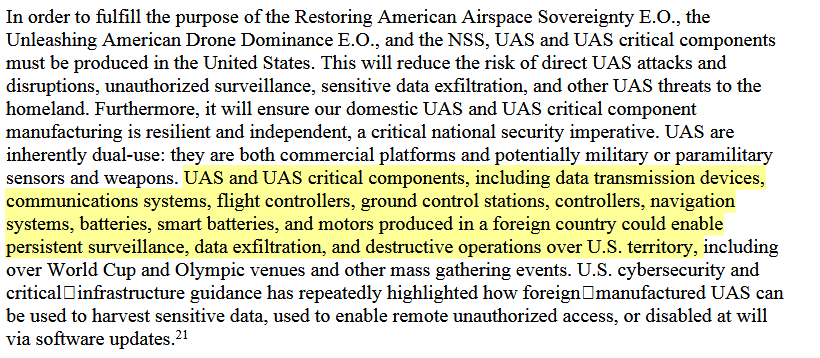
Here's what an extended Dec 22nd FCC document says regarding "critical components," as well as "communications and video surveillance equipment and services":

This is further elaborated upon here, in a passage that appears in less detailed form in the main public press release:
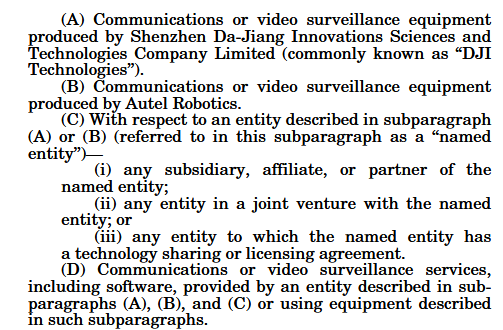
And here's what the FY25 NDAA says:
I'm going to look into the critical component aspect of this more, and I'll report back on Bluesky, here, and elsewhere.
Why Is The US Ban on Foreign Made Drone Imports Bad?
I've been harping for years about why it'd be a bad idea to ban DJI drones, as well as other Chinese and foreign made drones, in the US. I'll quickly reiterate my points here.
The US Doesn't Make Any Comparable Drones.
American-made drones are way more expensive, way less reliable, and way less fit-to-purpose for standard civilian drone tasks than those made in China, as well as in other nations.
Why do we suck so bad at drones? In large part, prioritization. Chinese drone makers have dominated the global consumer market since 2015. The vast majority of consumer drones sold around the world and in the USA (up until now) are made in China, and the vast majority of those drones are made by DJI.
According to some estimates, DJI holds something like an 85% market share in the USA today. Over one million drones are registered officially with the FAA as of 2025, and over 433,000 of those drones are explicitly registered by their users for commercial (money-making) purposes.
We can presume the vast majority of those drones are foreign made, which means that their owners will not be able to replace them with a comparable model in the future.
Have we ever seen such a popular and widely-adopted product so suddenly banned by regulators, in the course of American history? (Seriously, tell me if you can think of comparable examples in the comments).
While there were impressive US-based competitors to DJI for consumer drone customers back in the 2010s, they largely dropped out of that market by 2017. In part, this was due to China's major advantages in cheap electronics manufacturing. But their failure was also due to US drone makers simply being unable to figure out how to make drones as high-quality and user-friendly as those produced by DJI.
None of this was inevitable.
US lawmakers could have, and should have, intentionally supported these US drone-makers long ago.
But they didn't. Instead of making strategic investments to help American companies produce consumer-friendly and secure drone products capable of competing with Chinese offerings, our leaders and our business luminaries largely shrugged their shoulders. And decided to focus on making drones for the military and cops instead.
These were two deep-pocketed markets where US companies faced less competition from abroad, in large part due to a succession of US government regulations, rolled out since 2017, restricting the use of Chinese drones by the military and by federal agencies. This is still the case today.
Fact is, US drone makers just aren't offering the affordable photography and map-making oriented Chinese drone products that so many Americans have come to rely upon professionally and personally.
Nor do they seem interested in doing so, at least any time soon.
This means that Donald Trump has banned an entire class of high-quality and widely-used consumer tech products, which many Americans use to make a living, that truly has no viable, legal substitute.
I suspect the vast majority of Americans who use drones productively and for fun today won't switch to the crazy-expensive and inferior US offerings available today: they simply will stop using drones entirely as a result of this decision. And a lot of genuinely innovative productivity and creativity will be lost in the process.
People Who Make a Living With Drone Data are In Deep Trouble
Today, a lot of people (including me) make a living by using drones to collect data, including video, photos, and geospatial mapping information. These people and professions include realtors, scientific researchers, disaster responders, farmers, videographers, journalists, transportation managers, infrastructure inspectors, construction agencies, and many, many, more.
The vast majority of these people currently rely upon affordable Chinese-made drones to collect the information they need to do their jobs. Per this data, the global drone services market size was about $33.5 billion in 2025, which North America held the highest share of. This was predicted to be on a clear upwards growth rate. Now? Not so much.
The Trump administration and American drone companies appear to be, far as I can tell, completely ignoring all of these people.
Indeed, not even the police - who are at least a market that US drone companies actually care about - are happy with this foreign drone ban. They also use foreign-made drones extensively, and they're angry about this move and what it means for their ability to continue the surveillance programs they've been building out for the last decade.
Far as I can tell, the only people happy about this are politicians who don't know or care about drones, MAGAs like the Trump family with drone investments, and the drone companies and their creepy Silicon Valley investors that lobbied assiduously for years to ensure that the foreign drone ban would go through. Hooray?
But Aren't Chinese Drones a Security Risk?
There are some real security concerns associated with Chinese drone technology.
And indeed, I believe the right way for the US to address this would have been to ban the use of foreign-made drones by military, police, and by government agencies and all other entities engaged in sensitive activities.
This could have been accompanied by proactive government funding pushes to support a healthy ecosystem of consumer-focused drone companies motivated to produce affordable, secure, and attractive small drones for a global market understandably leery of China.
Instead, our leaders have decided to give military and cop-focused drone companies a sweet handout while offering nothing but a middle finger to the huge number of people who rely upon drone data for other purposes.
Somehow, I don't think China has ever been interested in weaponizing drone data collected by Americans who study endangered ferrets or who grow chardonnay grapes. Still, the law in its majestic equality has ensured that these people are now cut off from affordable and high-quality drone tech, too.
But that's not the worst part.
Banning Foreign Drones Is Going to Create New, Worse Security Risks
I suspect that by banning easily-trackable Chinese drones made by huge international companies like DJI (who at least were willing to make concessions to US security concerns), Trump's decisions will now force a bunch of people, including me, to get back into building their own drones again.
These drones will be far more difficult to track, intercept, or control than the Chinese-made consumer products of today. While some people (like me) will take pains to ensure our custom-built drones are legally compliant and registered, I feel confident that many builders, both intentionally and due to simple ignorance, will not.
What's more, these drones will be built by actors who now, unlike back in 2014, have access to a vast sea of easy-to-find technical information gleaned from the War in Ukraine and other global conflicts on how to build and weaponize small and hard-to-track drones.
Consider the case of Skyler Philippi, a Nashville aspirant-terrorist dingleberry who was arrested by federal agents in November 2024, on charges of "attempting to use a weapon of mass destruction and attempting to destroy an energy facility."
In the official FBI complaint, investigators note that Philippi intended to use a drone to help him carry out this attack, and he attempted to build one himself.
But crucially, Philippi failed to build a functioning drone.
He gave up on the project.
Instead, he requested the undercover agents provide him with a consumer drone - and while it's not clear from the complaint, I bet this was an easily-trackable, cheap, remote ID compliant consumer drone from DJI:
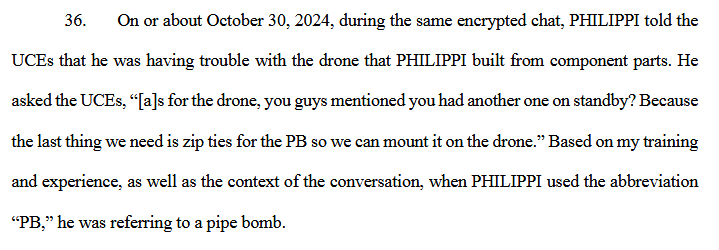

What would Philippi have done if he hadn't had access to a cheap alternative drone - a consumer product that he probably didn't know was specifically designed to be tracked by law enforcement?
He'd likely have persisted in building his own, intentionally very-hard-to-trace weaponized drone.
Philippi might even have succeeded.
No, I don't feel safer after this drone ban. You shouldn't, either.
Ultimately, Trump's decision to ban all foreign drones is a stupid, short-sighted hand out to corporate interests that will take jobs away from hard-working Americans and will harm national security.
But hey, that's 2025 for you.