
War Crimes With Drones, Social Media, and the Elusive Butterfly That is Shame
If I had to pick one overarching theme to describe our current global moment, it'd have to be "shamelessness."
The concept of shame, or the lack thereof, comes up in a lot in the research work I've been doing on how combatants are increasingly using small drones to target and kill civilians on battlefields around the world.
On one level, the connection here is blindingly obvious. International humanitarian law depends in large part upon shame - the idea that if you do this horrible thing, beyond the threat of prosecution (which we all know may or may not actually occur), we will also threaten you with shunning and exclusion from polite and professional society.
As anyone with eyes has likely figured out by now, these social norms are in deep trouble in 2026. There's lots of evidence of this from lots of different conflicts - but I believe that the massive and ever-escalating uptick in attacks on civilians with small drones constitutes a key symptom of the problem.
Here's an interesting fact about targeted attacks on civilians with small drones (and I specifically mean small, cheap FPV, DIY, and consumer drones here): we were seeing very few of them until January 2024. And then suddenly, in both Ukraine and in Syria at almost the same time, we began to see a lot of them.
We don't exactly know why it suddenly became so much more popular to hunt and kill obvious civilians with cheap FPV and consumer drones in both Syria and in Ukraine at approximately the same time, but there are some rather interesting clues.
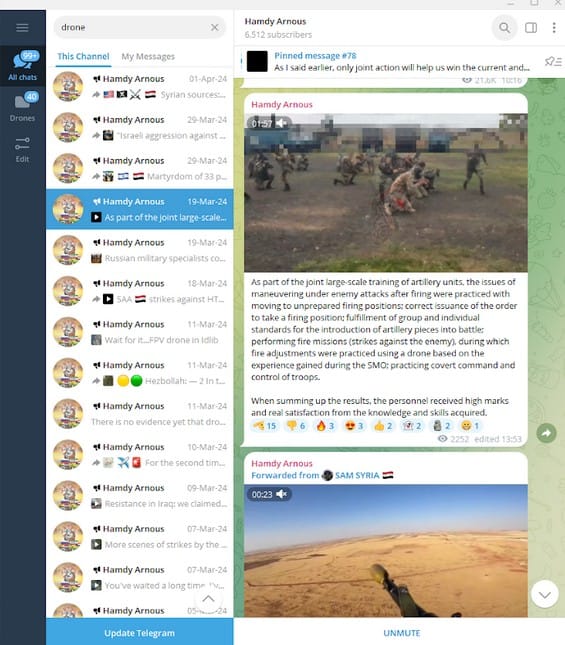
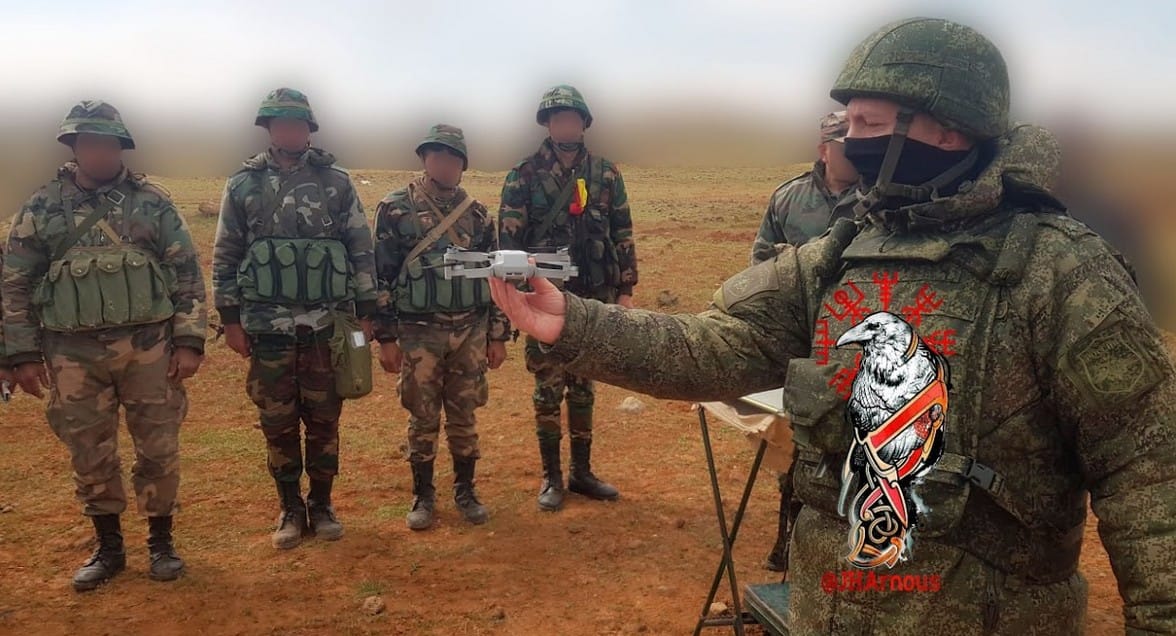
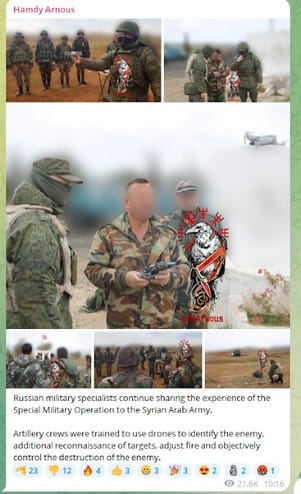
some screenshots I've preserved of Telegram posts describing Russians training Syrians to fly drones in 2023.
Specifically: we know that Russian instructors with drone experience from the Ukraine battlefield were training Assadist Syrian Arab Army forces on FPV drone operations by early 2023, as the White Helmets pointed out to me when I spoke with them at the time, and as I verified via Telegram posts. We know this because they were posting pictures of the trainings taking place. And they didn't stop posting, even when they were using these drones to kill civilians.
As the White Helmets discovered in 2024 (and related to me) in a number of cases, they were able to find drone footage of attacks they'd responded to on Telegram. The perpetrators obviously weren't ashamed: they were proud of what they'd done.
Almost immediately, one could see a pattern developing in the language that combatants used in these and similar Telegram posts that appeared to depict drone strikes against apparent civilian targets.
No, they didn't outright say things like "we killed a civilian, we know we did it, and we think that's good." Instead - perhaps responding to some tiny, vestigial remaining remnant of shame - they'd claim that the civilians were actually combatants in disguise, even if such a claim seemed obviously absurd. It's a fig leaf over a war crime. But in our current climate, it is interesting that combatants still are even bothering with such a fig leaf at all.
(It is also interesting that, curiously, forces in both Ukraine and in Syria appear to have come to near-identical conclusions about the value of using FPV drones to kill and terrorize obvious civilians at almost the same time - but that's a topic for further investigation).
Cases in which perpetrators of war crimes merrily documenting themselves doing the war crime for posterity are not exactly novel: we can point to many cases in the 19th and 20th centuries where smiling soldiers wielding bloody swords posed with the bodies of their victims for the camera, or the engraver, or the scribe.
But I'd certainly argue that the advent of social media means that we're seeing a lot more of this behavior than we ever have before, at a greatly accelerated rate. In the past, a combatant in a war zone could feel reasonably confident that they could control who had access to their own photos and video documenting their own war crimes (even if this sometimes was not the case).
Today, a perpetrator doing the same thing must know implicitly that their war-crime footage will be immediately blasted around the planet, to be viewed by absolutely everyone, including the victims of their attacks and those who support the victims. To post such footage thus becomes a very deliberate public statement. In a sense, the creator is intentionally setting up a Rashomon-like dynamic of comparative experience, via the medium of clickbait: instead of denying that they did it in the first place, they instead implore the global online audience to Do Their Own Research.
Meanwhile, the small drone platforms that these attackers use actively facilitate this kind of combat communication. Both FPV kamikaze drones and consumer drones carry onboard cameras, which stream high-resolution video back to a ground station below.
Even if the drone itself is destroyed in the process of an attack, the footage of both its and the victims last moment is thus preserved. This has created an entire deeply ghoulish genre of social media videos that depict terrified soldiers -and sometimes, civilians - desperately trying, and failing, to run away from a weaponized drone before it rips through their flesh.
Up until 2022, this type of death footage was largely only exposed to the public by means of rare and highly-publicized military leaks: today, I could find you hundreds of these snuff-videos on Telegram in approximately two minutes.
With all this in mind, I want to talk briefly about the arrival of one of the most impressive specimens of this genre of "knowingly posting drone videos of apparent war crimes on Telegram" that I think I've ever seen.
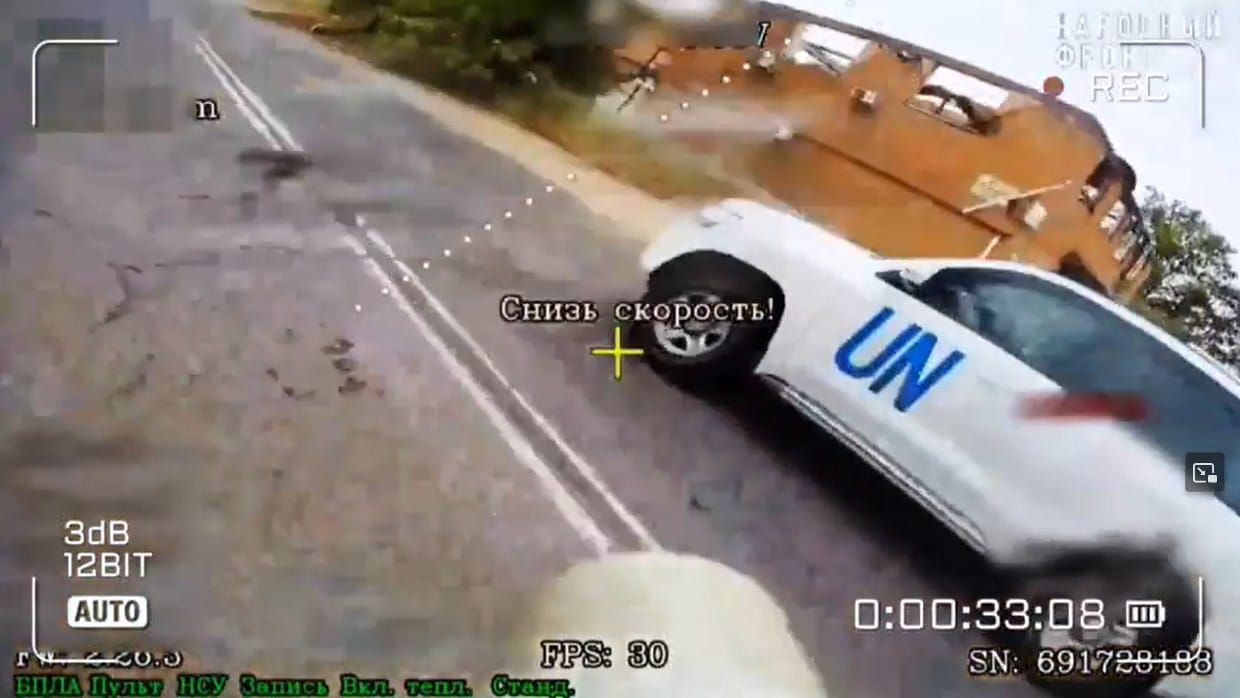
On May 14th, a clearly-marked convoy of UN aid vehicles was heading to Kherson's often-targeted Ostriv district when a Russian FPV drone slammed into one of the vehicles. Present in the convoy was Andrea De Domenico, OCHA’s head of office in Ukraine, who was fortuitously able to capture video of the attack as it happened with his mobile phone.
Russian military blogger osvedomitell_alex initially published footage of the attack on May 15th, then apparently thought better of it, deleting the video a bit later.
Not that the deletion really mattered.
Other Russian Telegram milbloggers had reposted his content (thus preserving it), as was only foreseeable. What's more, the post was archived immediately by various archivers (including myself). Thus, it will live in perpetuity.
One wonders why osvedomitell_alex even bothered to delete it in the first place. A vestigial shame receptor? Fear that the Russian authorities (who are already cracking down on Telegram) might not have wanted him to share that particularly damning video? It's hard to say.
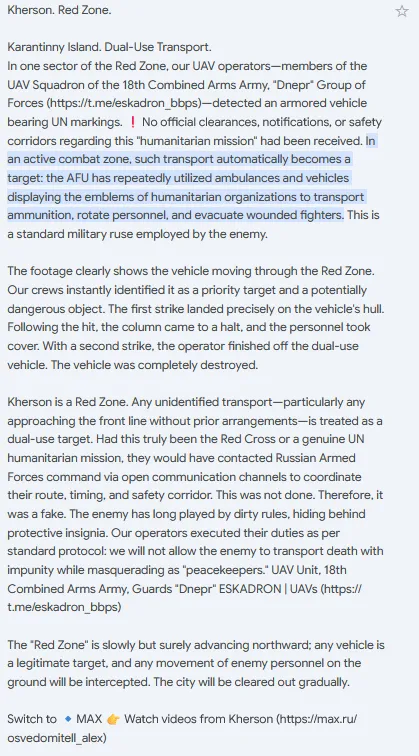
In any event, here's how osvedomitell_alex attempted to justify the attack in this initial sorta-deleted post (translated from the original):
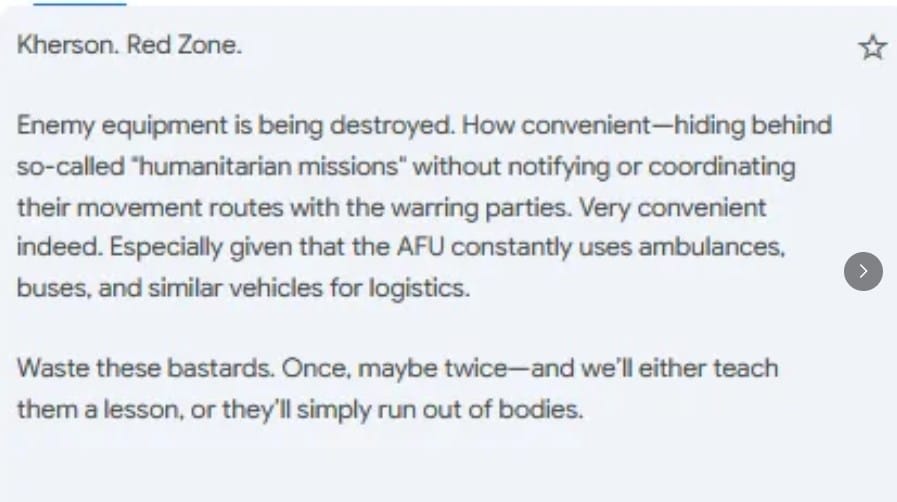
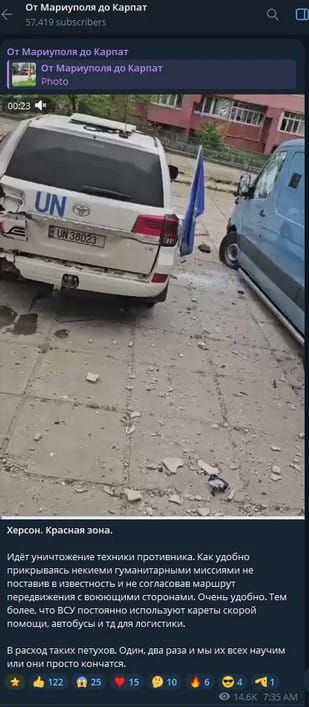
Soon after deleting the original video, an apparently still-cranky osvedomitell_alex posted once more about the attack on the aid vehicles, substituting the video with a still-image of what is obviously a white UN truck:
Not content to leave matters there, a few hours later, osvedomitell_alex doubled down yet again on his attempts to justify slamming FPV drones into apparent civilian targets in yet another still-live Telegram post:
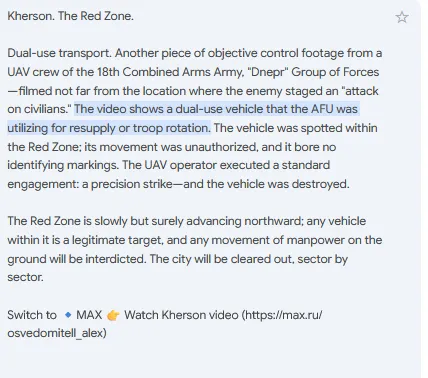
If you're someone who's been marinating their brain in milblogger Telegram for years (as is unfortunately the case for me), this lie-riddled rhetoric attempting to justify a war crime is all deeply familiar. Blah blah blah, dual-use vehicles, blah blah blah, aid worker movements were unauthorized, blah blah blah, dirty rules and hiding behind protective insignia. Only one thing is unusual about these posts: unlike so many similar justifications, it does not specify that the targets were "terrorists."
Indeed, nowadays, we hear this kind of sloppy and low-effort post-hoc justification for egregious breaches of IHL all the time, in so many venues, that it runs the risk of becoming banal.
The United States under our lethality-maxxing Department of War now does this kind of thing all the time, claiming that fishermen on boats are drug dealers (which isn't a death sentence, last I checked). In the horrific conflict in Sudan, both the RSF and the SAF issue regular statements in which they deny their own war crimes, accuse the other side of war crimes, and pointedly refer to one another as terrorists. The IDF issues regular murky justifications for killing civilians, blowing up aid workers, and destroying civilian targets - and so on, and so forth.
In concert with this grim trend in global conflict, I constantly hear well-meaning people issue world-weary proclamations that IHL is dead, no one cares about war crimes anymore, and that we all will just need to adapt to a world where even the veneer of legality in warfare has been shed. Some speculate that this may even be a good thing - a removal of the fig-leaf of civility that hangs over war, a return to certain nasty, fundamental truths about the ugliness of human conflict.
And that's exactly where the banality risk that I just mentioned comes into play.
By constantly flooding the zone with vociferous denials that they've committed a war crime in the first place, or hand-waving in the general direction of justifying them, the combatants of today are getting exactly what they want: a global population increasingly numb to egregious violence against civilians, and increasingly convinced that nothing can actually be done to stop or even meaningfully diminish the bloodshed.
While I can't exactly blame someone for looking at the dismal global situation and concluding that international law is somewhere in between a rotting corpse and a sick joke, I also think that subscribing to such a defeatist viewpoint plays into the hands of the worst people in the world.
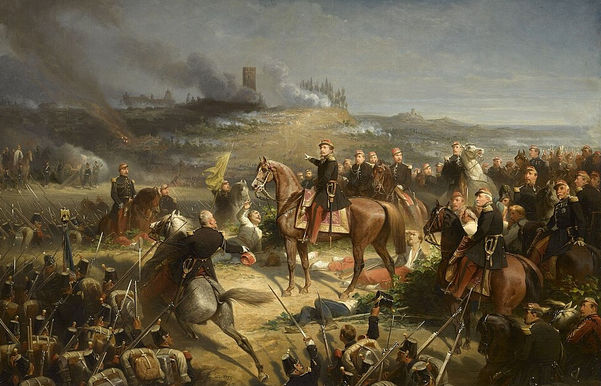
Since the advent of IHL, way back in 1862 when Henry Dunant first published his book on the horrors of the Battle of Solferino, the entire idea of trying to put some kind of constraint on warfare has always been both wildly ambitious and deeply flawed. Defining and attempting to stop war crimes has always been a complex and too-often soul-destroyingly ineffective pursuit: hard as we work to stop the violence, it somehow still keeps coming.
And yet, completely shit as everything clearly seems to be right now, and as terrifying as our modern war machines certifiably are (I know a little bit about that), I do think that our world has been improved by the concept of IHL - by the very idea, which was once strikingly novel, that civilians have any kind of legal protection or inherent human rights at all.
Infuriating as the deliberations, details, and pedantic nature of IHL can often be, and as terrifying as the current global breakdown of norms around civilian protection indisputably are, I think we would be very foolish indeed to conclude (just as the war-crime perpetrators would prefer) that the entire apparatus is pointless and that there's no point in continuing it.
Because there is value in asserting that norms and rights exist, even in the face of denial, lies, and shamelessness - and because I do believe that it is better to continue to fight monsters than to throw up our hands and conclude that while we don't much like the monsters, they do make some salient points about the essentially fallen nature of mankind. (No. The monsters are wrong!).
And to return to an earlier point: I still maintain my faith in the power of shame, elusive a butterfly as the concept may appear to be in this deeply stupid time to be alive. As humans, our enforcement of behavioral norms isn't a one-way-street: even if a given norm, such as "don't murder obvious civilians with tiny flying robots" is eroded, this does not mean in any sense that it is therefore dead forever. Human behavior ebbs, yes - but it also flows.
We can re-establish these norms, and we can fight to bring the perpetrators to justice. And I do mean we. Because it is incumbent upon all of us to keep telling liars that they are liars, and murderers that they are murderers, even if they do post a lot of weasel-words to the contrary on Telegram.