
Maybe Telling Americans They're Useless Eaters Who Must Perish for the Glorious AI Revolution Was a Bad Idea: Midterm Thoughts

Americans really, really, really hate data centers.
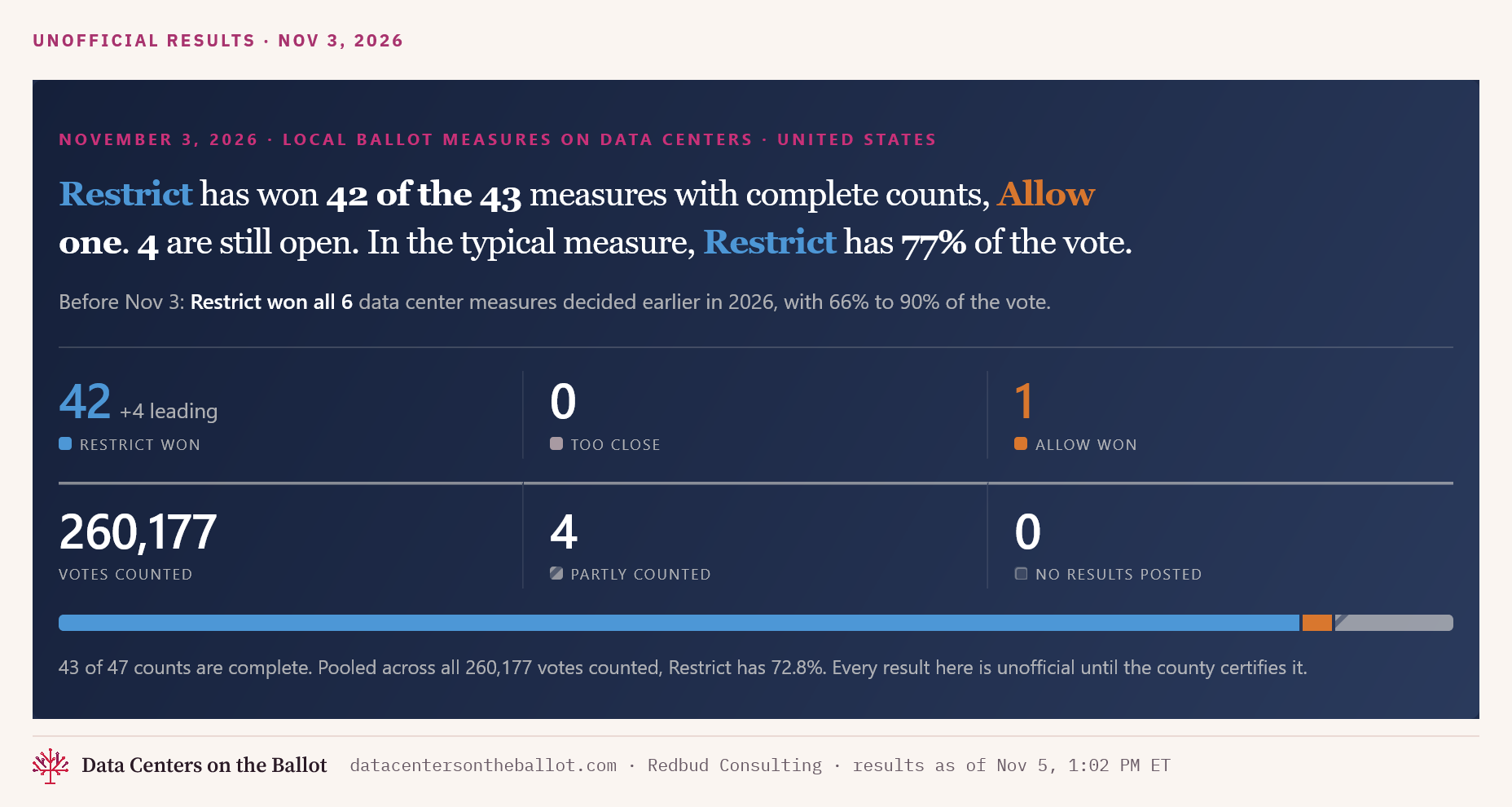
Lest you harbored any residual doubt about this, the midterm elections just proved it. Take a gander at these apocalyptic numbers for data center advocates, as compiled by Redbud Consulting:
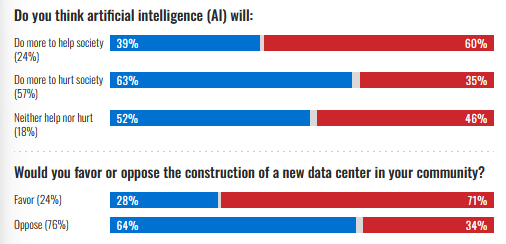
Or consider NBC's exit poll data, which currently shows that solid majorities 1. think that AI will do more to hurt society than to help it (57%), and 2. oppose the construction of data centers in their community (76%):
None of this should have come as a surprise. At least, if you were paying attention to the last year of polling data focused on American attitudes towards AI.
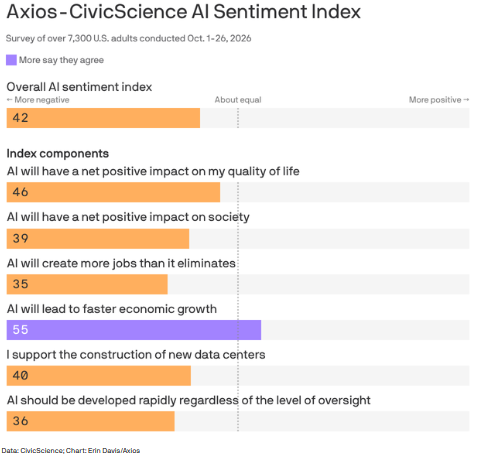
Let's look at this very recent Associated Press poll data, which found (among other things) that 64% of Americans think AI is developing too quickly, and 78% believe we need policies that protect US workers. Or perhaps this also-very-recent Axios-CivicScience survey data, which finds that Americans are highly skeptical of every claim commonly made about the benefits of AI growth except for one: while a majority think it'll lead to faster economic growth, majorities also think that growth won't come with more jobs:
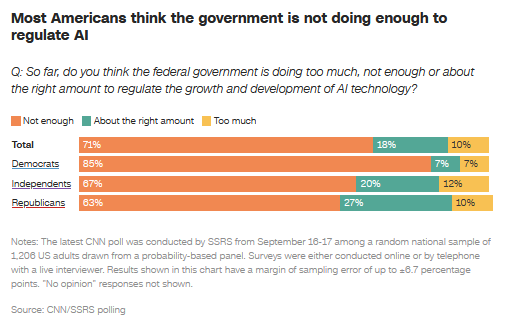
Or this September 2026 data from a CNN/SSRS poll, in which respondents do not exhibit the sort of bubbly optimism about their impending irrelevancy as useless meat-sack eaters that big tech companies would probably want to see:
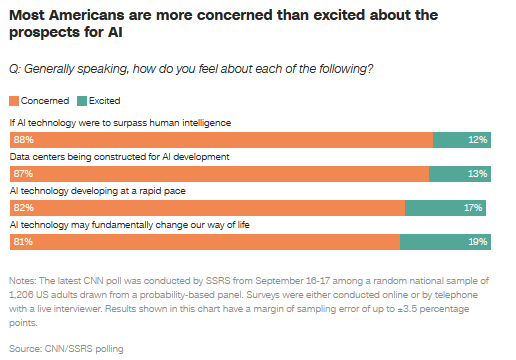
What's more, the CNN poll found that 7 in 10 Americans believe the federal government is not doing enough to regulate AI - a belief shared by voters across the political spectrum, which ought to be very attractive red meat for our impending Democrat politicians:
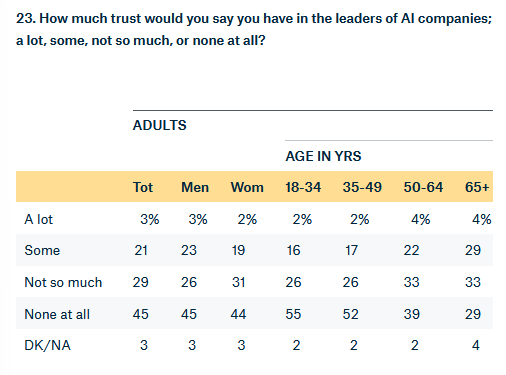
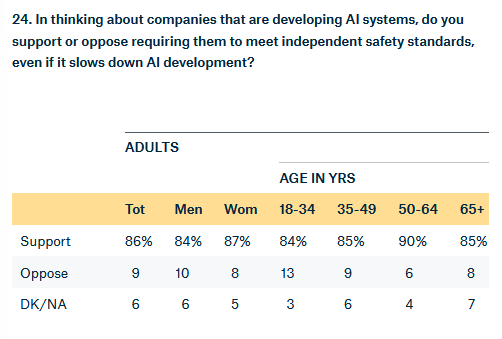
At the same time, a September 30th Quinnipiac University poll found that Americans appear to view AI company leaders as approximately as trustworthy and qualified to regulate themselves as a man in an unmarked white van offering little children free candy:
Personally, I think this midterm vote was about hatred for data centers, yes.
But it was also about more than that.
I think Americans hate data centers not just because they're data centers, but also because they are tangible, touchable representations of the big tech industry that has spent many years abusing their trust and worsening their lives.
They are big, ugly buildings that exist as constant reminders of how (seemingly) tech companies can do whatever they want to whoever they want, and of how our government constantly refuses to craft regulations that might stop them.
And to people who have spent years feeling totally powerless in the face of all this technological change, voting against data centers represents, for once, a meaningful way to put the brakes on.

It's possible that this public relations apocalypse for AI and for big tech in general could have been averted, at some point, somewhere. There is a theoretical timeline shimmering somewhere out there in the void in which humanity figured out how to roll out LLM technology - which does have many genuine positive uses - in a sensible, humanist, and non-abusive way. But these companies, as the US big tech industry has been doing for many years now, let total arrogance steer the ship every step of the way.
Instead of carefully monitoring their reputation with general audiences, both the MAGAs controlling the US government and their attendant big tech leadership remoras spent the last two years gleefully acting as if they had slipped the surly bounds of reality itself. (I wrote about that a while back). This unholy alliance truly believed that after November 2024, the woke horde of Democrat-voting NPCs had been defeated forever, and that the future was now theirs to grab in nonconsensual-fashion by the genitals.
With this misplaced confidence, they leaned into publicly denigrating and terrorizing normal people with normal concerns about the impact of AI, AI-powered surveillance technology, and its attendant mega-scale data center build-out on their jobs and communities.
Instead of attempting to assuage those fears, or even present a thin veneer of vaguely-human-sounding empathy crafted by diabolically clever PR professionals, they chose to extend a middle finger - while publicly ruminating all the time, on TV and on social media and in the newspaper, about how their technology was probably/maybe/certainly going to destroy humanity.
Instead of accepting realistic national-level regulations on AI and tech writ large, they called for unrealistic global coordination bodies out of one side of their mouth (using self-serving arguments that would still grant the companies too much influence over the supposedly independent evaluators they're calling for), while out the other side of their mouth, funding political groups that passionately oppose sensible rules on AI development.
In its continuing effort to position itself as the reasonable regulation-friendly AI company, Anthropic quietly pitched a bill to Capitol Hill last month that would allow the government to block an AI model's use or release - which sounds reasonable, until you realize it only kicks in under a highly specific set of parameters defining "foreseeable imminent risk," like "killing or seriously injuring more than 50 people."
As they bargained over exactly how many people their tech should legally be allowed to kill, big tech leaders and influencers attended creepy "consensual non-consent" sex parties, extolled the intellectual virtues of Harry Potter fan fiction, sat down for heart-to-heart dinners with Donald Trump, and sniggered about how chatbots will wrest power away from the dread influence of college-educated bitches with opinions.
In lieu of spending money on finding ways to truly address and answer normal people's worries about AI, privacy, and data centers, these leaders instead pumped their philanthropic cash into nonsense "AI safety" think-tanks, groups which appear to largely view these worries as silly nonsense for net-negative morons. No, these well-paid researchers would instead focus the bulk of their (debatable) intellectual firepower on bong-gurgle-type existential risks.
Such as: "What if we make an AI that is hella smarter than us so it enslaves humanity, but also it is like super-mad at people who knew supersmart AI was possible but didn't work tirelessly to bring it about, so it tortures us forever?"
From the perspective of our august AI and big tech leaders, too many of whom believe this moronic ghost-story nonsense themselves, this prioritization of risk was, somehow, perfectly reasonable.

After all, who cares what Ethel and Bob from Monroeville, Ohio think about their stupid little worm-jobs and their nasty little worm-communities, when the singularity that promises to transfigure appropriately-pious techbros into beings made of pure energy is imminent? Who's got time to waste on the petty fears of public-school-educated losers, when you're working on saving an infinite number of future lives from being tormented by theoretical basilisks?
As they pondered inane blog posts about the life outcomes of brine shrimp, pretended to be good at MMA, and swanned around at peptide parties, these tech leaders smugly assumed that conservative control was so complete that they would never have to face a truly hostile regulator, a bloody-minded federal lawyer, or an angry mob. That their pathway to becoming feudal dork-ass god kings over a sea of frightened peasants huddled for warmth in slums constructed of rotting Amazon Prime boxes was assured. Who was going to stop them?

For many people, including myself, observing this insulting rumspringa for delusional assholes was an intensely unsettling experience. Especially because, at least for a bit, it seemed like the reality-deniers might be getting away with their program of constantly committing crimes and publicly insulting the public, while sneering at anyone who complained about it.
In our darkest moments, we found ourselves wondering if perhaps these sniveling khaki-shirt wearing MAGA operatives and glassy-eyed rationalist twerps with AI researcher jobs actually had figured out the cheat-code to warding off the laws of objective reality in favor of their own greedy self-interests.
But of course, they hadn't.
Now is the time when the bill comes due, both for MAGAs and for the big tech overlords who have spent the last two years latched onto their side.
And it is a hefty bill indeed.
Because, as I've just sketched out above, prominent American technology and AI companies have spared no expense, left no stone unturned, in their pursuit of making the average person hate them.
We know that this total electoral drubbing has come as a huge surprise to these supposed masters of the information-space, because that's exactly what they're whining about right now - in a pitch so high and keening that it's detectable only to dogs and people who still use Twitter.
It seems to me that until now, much of big tech was operating under the pleasant delusion (among so many pleasant delusions) that the public still liked them and their products just as much as it did in the early to mid 2000s. Back when everybody was getting their first iPod, back when tech executives were seen as young and cool and left-wing, back when you could still write lofty editorials about how the Internet would usher in a new era of democracy and global peace.
Being a delusion, this false belief simply ignored how big tech had since spent years tormenting, abusing, violating, scamming, and brain-melting the average American, in such a way that even the most checked out are starting to look at their location-tracking phones, at their grotesquely manipulative social media feeds, at their advertisement-delivering smartcars, and seriously contemplating if these objects are making their lives worse.
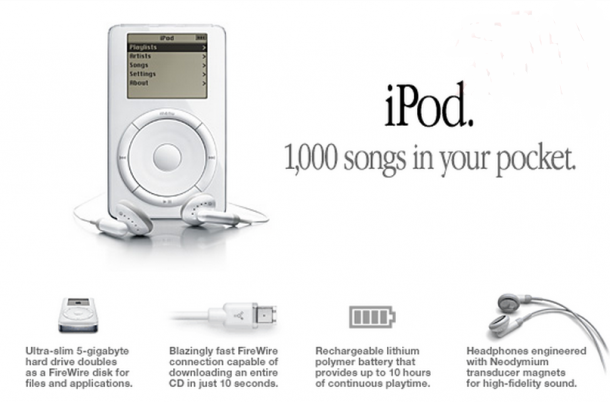
Once, tech was in the business of making people's lives better, or at least more interesting and fun. I have misty-colored memories of the 90s and the 2000s myself, the period when I was excited to follow along with each new innovation, each massive upgrade in the capacities and creativity of the Internet. Now? We've been collectively primed to expect, over years of bitter experience, that new technology innovations will make our lives worse. (I wrote about that here).
More than that, we've been forced to recognize - in part because big tech companies keep gleefully reminding us - that we are no longer big tech's customers. We are instead their raw material, the fleshy, irritatingly demanding repositories of the raw material in the form of personal data and creative output that they require to keep on growing, growing, growing.
And now, thanks to the transformer revolution and the resulting massive progress in LLM chatbots, big tech companies managed to convince themselves that they don't even need us anymore - that they can replace the old data-harvesting business model that was unpleasantly dependent on the continuing existence of whiny human beings with something much more palatable.
They bought into the idea that with the help of the Republican party, they could abscond with the public entirely, and replace them with far more accommodating AI agents. And since they believed that everyone who wasn't them was incredibly stupid, they yapped about this in public. All the time.
Unfortunately for them, a lot more people were listening carefully to their Twitter fantasies of ruling as computer god-kings than they'd realized.

Even worse for big tech, the American people now do not just distrust and fear them for their own well-documented crimes and abuses. Now, they wear the rotting, still-squawking carcass of Donald Trump around their necks. And it will be very hard to wash that stench off.
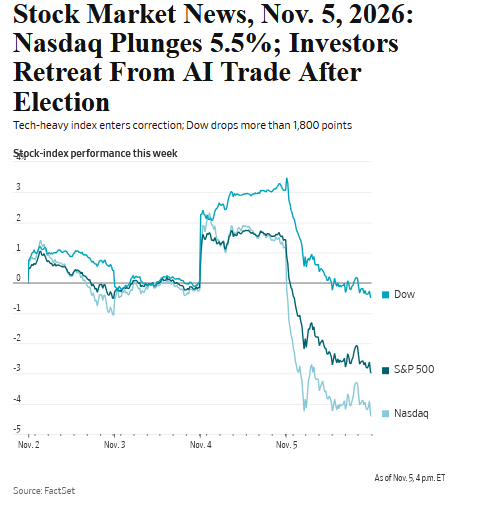
As I write this, on November 5th, technology stocks have taken a bracing kick in the teeth, to such a degree that the Wall Street Journal is hauling out the smelling salts:
We also have polling data on how Americans view big tech's association with MAGA's inept (now failed) fuck-muppet efforts to bring about a fascist revolution.
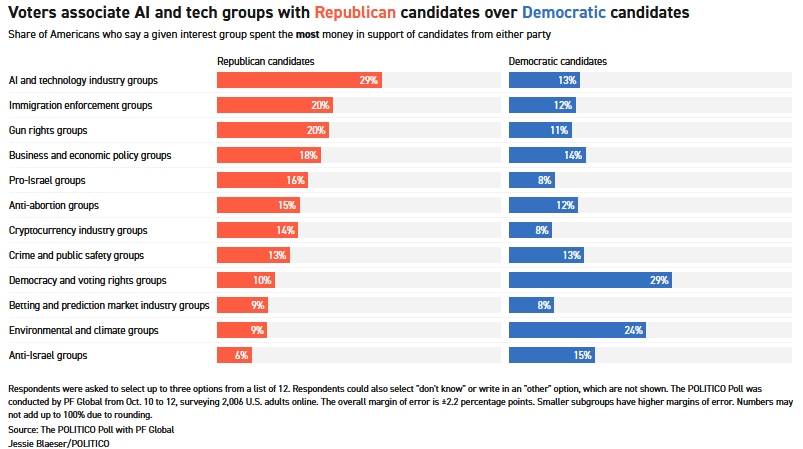
Per a October 20th Politico poll, American voters now believe big tech CEOs are largely Republicans - and a majority now associate both AI and the technology industry with Republican candidates.
Will big tech's leaders learn from this electoral bloodbath against data centers and against their own MAGA-intertwined interests - at least, right now, in November 2026? Will they recognize that this ass-kicking was of their own making, is the outcome of their own stupid and craven choices, and that they should review their current PR strategy of threatening the public with job-loss and constant intrusive surveillance? Will they grasp that betting the entire $100 million Napa Valley wine plantation on the 100o-year-Reich aspirations of a 80-year-old fascist with visible dementia was, in retrospect, a rather poor gamble?
I am not optimistic.
After all, these big tech leaders are people who have been swimming in a warm and comforting sea of delusion for years now. Too many of them have thoroughly tenderized their brains, like an oversaturated ceviche, in the acid-bath that is Elon Musk's Twitter. They are very rich people who have exceptionally well-honed defenses against the intrusions of reality.
But, luckily for us, and for the world, a majority of American voters do still accept the existence of reality. Thanks to them, Democrats have finally taken back the power required to jar the big tech industry back into the real world.
And we know that such efforts will be popular across the political spectrum, in a show of bipartisan support that is a very rare thing in our era of ultra-polarization. We know that a majority of Americans want to see these companies fitted with muzzles, shock collars, and credible threats to send them to the kill-shelter if they keep biting children and pissing on the furniture.
Which means that's now it's up to us - as voters, as citizens, as advocates - to loudly and ferociously insist that the Democrats use that power to bring big tech's forces of evil to heel.