
My Map of Small Drone Attacks on Civilians, and Russia's Drone Assault on the Elderly
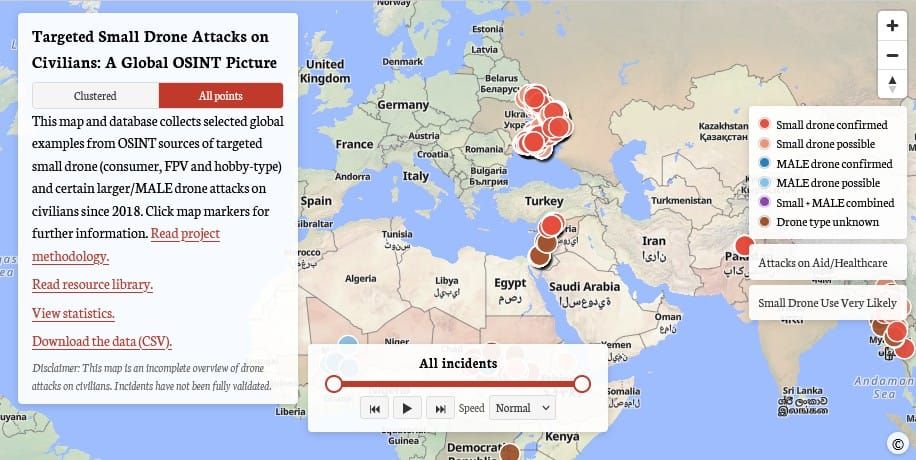
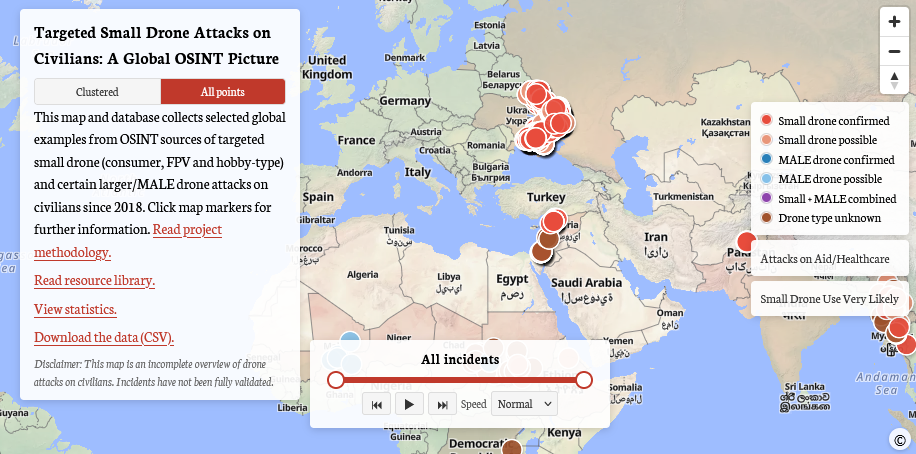
Over the last two weeks, I've made many improvements to my map of targeted small drone attacks on civilians from across the world.
You should go look at them.
These improvements include:
- Something like 2000+ new cases of small drone attacks on civilians from the Ukraine conflict, which I collected using scraping tools from official Ukrainian sources for initial extraction, than manually reviewed for veracity. (I believe I've removed almost all duplicate cases, but please let me know if you find any).
- A statistics page, with separate pages for each affected country, attacks on aid and healthcare, and injury types (when available).
- A timeline slider.
- A link where users can download a CSV version of the whole dataset.
- Two clickable map filters: one for attacks on aid and healthcare, and one for cases where the use of a small drones is either confirmed or very likely, according to the source materials (as opposed to probable).
In the course of manually reviewing all of those Ukraine incidents, one pattern in particular jumped out at me.
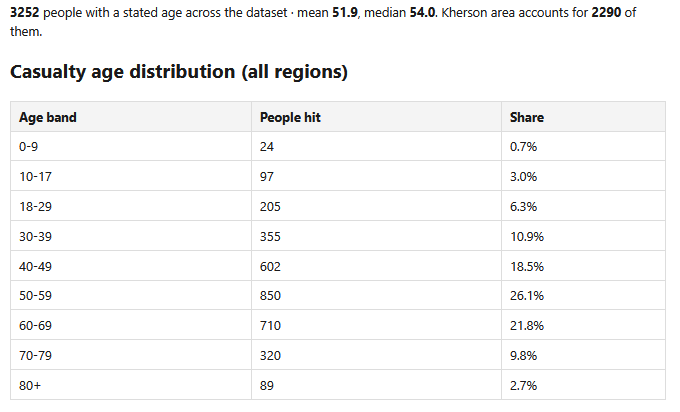
In Ukraine, the majority of the victims of drone attacks on civilians in my database are over the age of 50, out of a sample of incidents in which the age of those killed or injured are explicitly mentioned in source materials.
According to some very quick and dirty data analysis on my end:
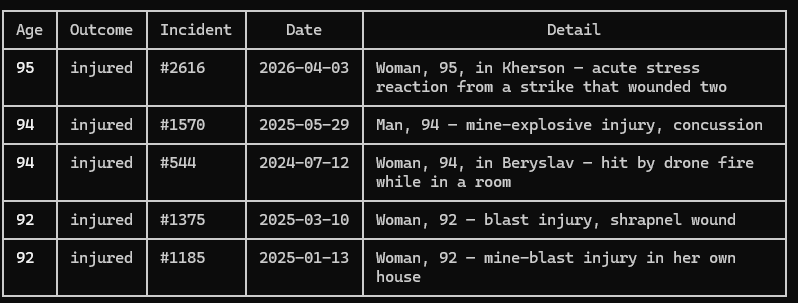
Within that 80+ category are a number of people over the age of 90:
On a purely demographic basis, this isn't really surprising.
About a quarter of the Ukrainian population was over 60 when Russia began its full scale invasion in 2022. And although most younger Ukrainians have either left dangerous front line areas or joined the armed forces, many older people have stayed put, both due to a lack of resources and, sometimes, due to personal inclination (in what is a very common global pattern).
In Kherson, the Ukrainian city that has been more relentlessly targeted by small "human safari"-type Russian drone attacks than anywhere else on the planet, a whopping 65% of remaining residents, as of July 2025, were over the age of 60. And so, if we view all these attacks on the the elderly with the gimlet eyeball of a statistician, then it is perfectly predictable that in a place with a whole lot of older civilians, we'd see proportionately more attacks on them.
When we consider this pattern of attacks from the lens of both international humanitarian law and basic human decency, it is shocking.
On a near-daily basis, Russian combatants are choosing to use drones to stalk, terrorize, and murder older people who are incredibly obviously civilians, assassinating them as they pedal their bicycles, wait at the bus stop, and linger in their own yards.
This is not a situation in which the aggressor is (as is traditional) lobbing some artillery rounds or some long-distance drones in the general direction of civilian targets without much care for who or what gets blown up. Arguably, it's even worse than that.
No, these attacks are largely being carried out by camera-carrying multirotor drones that stream high-quality video back to their pilots. According to some I've spoken with who have experienced them, these attacks feel personal, in a way that less-targeted, more general attacks on civilian targets don't.
In other words, these are precision weapons that are being used, precisely, to massacre noncombatants trying to buy groceries. Drone tactics that Russia is knowingly testing on a captive population primarily made up of retirees.
To pluck out just two cases of these attacks from the horrifyingly large number in my dataset:
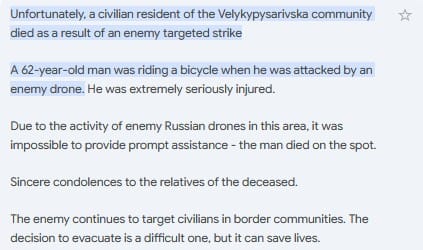
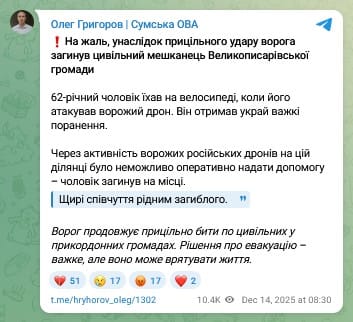
On December 14th, 2025, a 62-year-old man residing in Sumy Oblast's Velyka Pysarivka settlement went out for a bicycle ride. He was then hit with a direct strike from an enemy drone (which I strongly suspect was a cheap FPV "kamikaze" type aircraft), severely injuring him. Due to the presence of other Russian drones lurking above, first responders were unable to reach the injured man in time. Per a Telegram post from Oleg Grigorov of the Sumy Regional Military Administration, the man died at the scene.
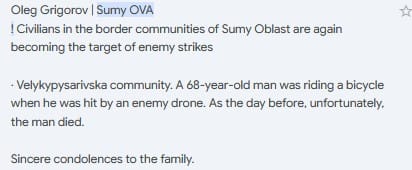
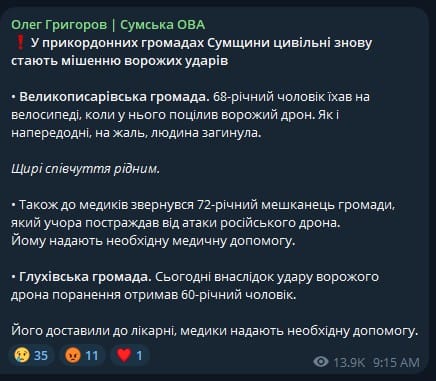
Almost exactly 24 hours later, on December 15th, Mr. Grigorov reported that another 68-year-old man from Velyka Pysarivka, riding another bicycle, had also been struck and killed by an enemy drone - in an incident so similar that I initially assumed it was an accidental duplicate. But it wasn't.
This is just how it is now on the front-lines in Ukraine, where in the eyes of the Russian invaders, one warm body is as good as any other to slam a low-cost $400 flying robot into at high speed.
We're clearly seeing a grotesque new genre of drone attack in conflict develop, a form of warfare directed at civilians. A style that dispenses even with the sinister gesture in the direction of justification that U.S. drone strike doctrine and its claims that all "military-aged males" are inherently justifiable targets does.
You can at least try to spin killing a working-age civilian adult, grotesque as such rhetorical games are: God knows that combatants have been doing this since we first started recognizing the legal status of civilians in war.
But even the Russians know there is no even vaguely plausible way to ethically or legally justify murdering 80-something year old women with drones as they wait at the bus stop.
Which means, as I wrote about earlier, that they've largely given up on even making the attempt. The Russians seem to have reasoned, unfortunately not without justification, that the old taboos and conventions that warned against blatantly targeting harmless civilians (without even trying to make up a semi-plausible reason) are now so toothless that they can be safely ignored.
I do not think those taboos and conventions are dead - or at least, I don't think they're doomed to remain that way. I believe that the norms at least can be resurrected if we want them to be, if we are willing to fight for them.
Unfortunately, all those people whose last moments were recorded by an explosive kamikaze drone can't be. Which makes our shared task of reviving those norms all the more important.